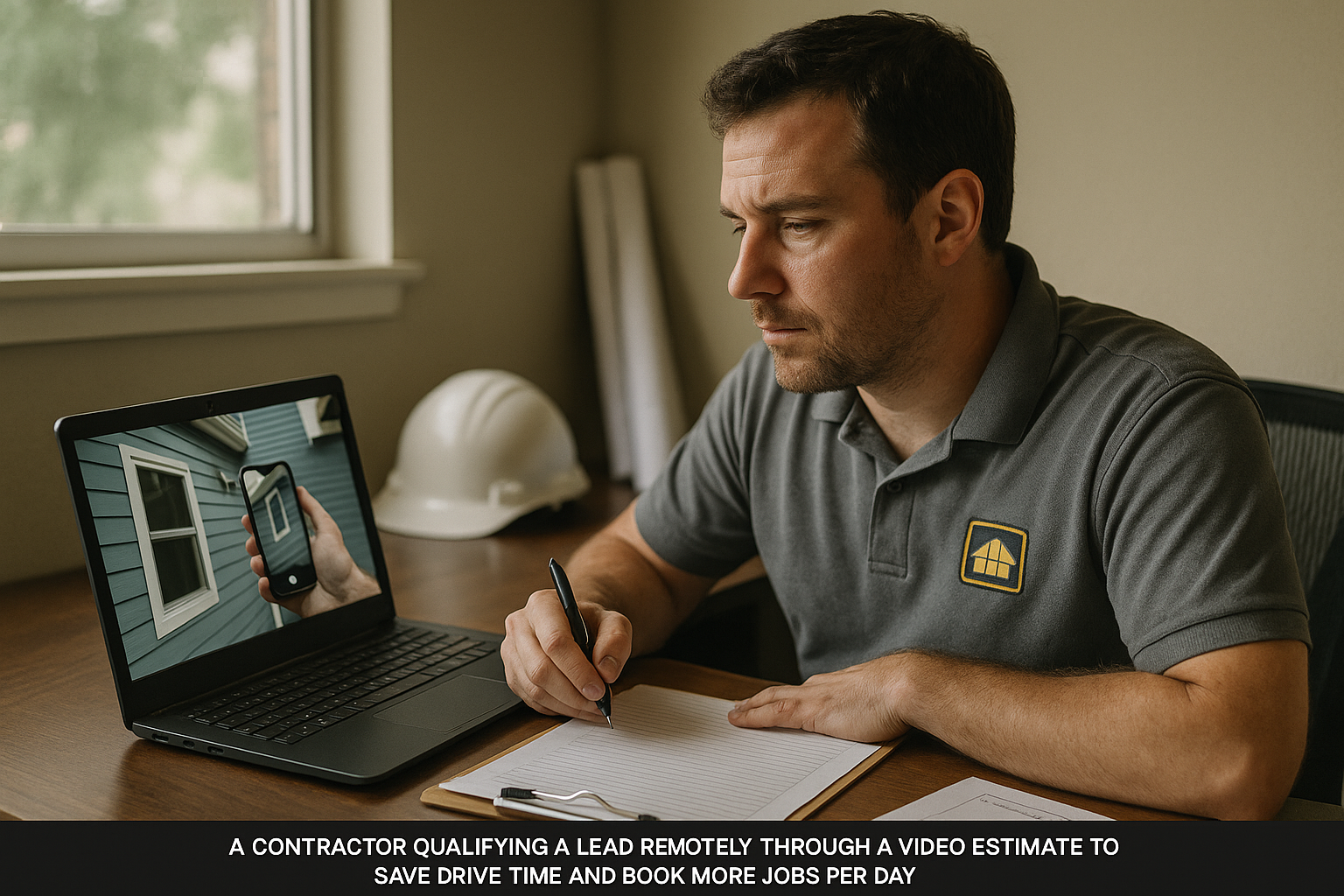
Virtual Estimates for Contractors: Book More Jobs Remotely
Quick Answer
Virtual estimates for contractors use video calls and photo-based assessments to qualify leads remotely before driving to the job site. This approach cuts windshield time by 40-60%, lets contractors run 3-4x more estimates per day, and filters out bad-fit projects before a truck ever leaves the yard. Trades with visible exterior work benefit most.
Virtual estimates for contractors are reshaping how contracting businesses qualify leads and book jobs. Instead of driving 45 minutes to a homeowner's property, spending 30 minutes measuring, and driving 45 minutes back for a lead that may never close, contractors are using video calls and homeowner-submitted photos to pre-qualify projects in 15 minutes from the office.
The math is compelling. A contractor who runs four in-person estimates per day can run 12-15 virtual pre-qualifications in the same time. According to HBR, leads contacted within five minutes are 21x more likely to convert than those contacted at 30 minutes. Virtual estimates let you respond faster because you are not stuck in a truck between appointments.
Why Contractors Lose Revenue on In-Person Estimates
The traditional estimate process is one of the biggest hidden costs in contracting. A typical in-person estimate consumes 2-3 hours when you factor in drive time, on-site assessment, and return travel. For a contractor running four estimates per day, that is the entire workday spent on leads that close at a 25-35% rate.
That means 65-75% of your estimate time produces zero revenue. For a roofing contractor driving an average of 30 miles per estimate, the annual cost in fuel, vehicle wear, and labor hours adds up to $25K-$40K. And that does not account for the opportunity cost of jobs you could not bid on because your schedule was full of windshield time.
InsideSales research shows that 78% of leads go with the first contractor to respond. When your team is stuck in traffic driving to an estimate, incoming leads wait. By the time you return the call, the homeowner has already booked with a competitor who responded in under a minute. The in-person-first model creates a bottleneck that limits both conversion rate and total capacity.
The problem is compounded for contractors in sprawling metro areas like Los Angeles, Dallas, or Atlanta where a single estimate can involve 60-90 minutes of driving. Every hour on the road is an hour not spent on billable work or lead follow-up.
How Virtual Estimates Work for Contractors
Virtual estimates are not a replacement for in-person inspections on every job. They are a qualification layer that sits between the initial inquiry and the on-site visit. The goal is to determine whether a project is a fit before committing drive time. Here is the standard workflow:
Step 1: Lead Intake and Pre-Qualification
When a lead comes in, your intake process (whether handled by your team or an AI assistant like Zoey) collects basic project information: type of work, approximate scope, timeline, budget range, and property address. Zoey handles this in under a minute, 24/7, capturing all the details your estimator needs. Salesforce research confirms 64% of consumers expect real-time responses, and automated intake ensures no lead waits.
Step 2: Photo or Video Submission
The homeowner submits photos or a short video of the project area via text message or a simple upload link. For roofing, that might be photos of the roof from ground level plus interior ceiling shots. For remodeling, a walkthrough video of the space. For painting, exterior photos from multiple angles. This takes the homeowner 5-10 minutes and gives your estimator 80% of the visual information they would get on-site.
Step 3: Video Call Assessment
A 15-20 minute video call replaces the initial site visit. The estimator reviews the submitted photos, asks clarifying questions, walks the homeowner through the scope, and provides a preliminary range estimate. This is where you determine fit: is the project in your service area, within your scope, and aligned with your pricing? If yes, you schedule the in-person inspection. If not, you have saved 2-3 hours.
Step 4: In-Person Visit (Qualified Leads Only)
The in-person visit happens only for leads that passed the virtual qualification stage. Your close rate on these visits jumps from 25-35% to 50-65% because you have already filtered out bad-fit projects, budget mismatches, and tire-kickers. Every truck roll now has a higher probability of producing revenue.
| Metric | In-Person Only | Virtual + In-Person |
|---|---|---|
| Estimates per day | 3-4 | 12-15 virtual + 2-3 in-person |
| Time per estimate | 2-3 hours | 15-20 min virtual, 1 hr in-person |
| Close rate on site visits | 25-35% | 50-65% |
| Drive time per week | 15-20 hours | 5-8 hours |
| Speed to first response | Hours (after current appt) | Minutes (from office/phone) |
Which Trades Work Best for Virtual Estimates
Not every trade or project type is equally suited to virtual pre-qualification. The key factor is whether the project scope can be reasonably assessed from photos and video before requiring physical measurement. Drift research shows businesses using technology to engage leads faster see 3x more conversions, and virtual estimates are one of the most practical applications of that principle.
Strong Fit for Virtual Estimates
Roofing: Ground-level and drone photos, plus interior ceiling shots, give estimators enough to determine scope, material type, and approximate square footage. Many roofers now provide ballpark ranges virtually and only visit for final measurement before signing. This is especially valuable for qualifying contractor leads before committing to a site visit.
Exterior painting: Photos from all four sides of the house, plus close-ups of trim, surfaces, and damage, are sufficient for initial scope and pricing range. A 15-minute video call confirms prep work needs and surface conditions.
Fencing: Homeowner-measured property lines combined with photos of terrain, access points, and desired style allow estimators to provide accurate preliminary quotes. The in-person visit confirms measurements and identifies underground utilities.
Solar: Satellite imagery plus roof photos and a recent electric bill provide enough data for a preliminary system design and savings estimate. Solar companies pioneered virtual sales and have proven the model at scale.
Partial Fit (Virtual Pre-Qual, In-Person Required)
Kitchen/bath remodeling: A video walkthrough shows layout, existing conditions, and space constraints. The virtual call establishes scope, budget alignment, and design preferences. Physical measurement and behind-the-wall assessment still require an in-person visit, but the virtual step eliminates 40-50% of unqualified leads before you drive there.
HVAC (replacement): Photos of the existing system, model number, and access area help estimators determine equipment needs. Virtual calls work well for replacement quotes but not for diagnostic service calls that require hands-on troubleshooting.
Poor Fit for Virtual Estimates
Foundation repair: Structural assessment requires physical inspection, measurement of floor slopes, and visual inspection of crawl spaces. Virtual pre-qualification can screen for obvious mismatches (scope too small, outside service area), but the core estimate must happen on-site.
Concrete/paving: Ground conditions, grading, drainage, and subbase assessment need physical evaluation. Photos can screen leads, but most of the estimate work happens in person.
Spending Too Much Time on Estimates That Never Close?
We help contractors build virtual estimate workflows that cut windshield time and double close rates on site visits.
Book Your Free Strategy CallReal-World Example: A Remodeling Company Doubles Estimate Capacity
A kitchen and bath remodeling company in the Los Angeles area was running five in-person estimates per week. Each estimate consumed a half day when travel was included. Their close rate on in-person visits was 30%, meaning they booked 1.5 jobs per week from five full site visits.
After implementing virtual pre-qualification, their workflow changed. The sales team ran 15-20 video calls per week, screening leads for budget alignment, project scope, and timeline. Only leads that passed virtual screening received an in-person visit. The result:
- In-person estimates dropped from 5 to 3 per week (less windshield time)
- Close rate on in-person visits jumped from 30% to 58% (better-qualified leads)
- Total jobs booked increased from 1.5 to 1.7 per week with less effort
- Estimator capacity freed up 8-10 hours per week for follow-up and project management
The revenue impact was significant. At an average job value of $35K, booking an extra 0.2 jobs per week translated to roughly $7K/wk or $364K/yr in additional revenue. The virtual estimate process cost nothing beyond a Zoom subscription and a slightly adjusted intake workflow. HubSpot confirms that 80% of sales require five or more follow-up touches, and the freed-up hours allowed the team to run more thorough follow-up sequences on pending estimates.
How to Set Up Virtual Estimates in Your Business
Implementing virtual estimates does not require expensive software or a complete process overhaul. Here are the practical steps to get started within a week.
Choose Your Video Platform
Zoom, Google Meet, or FaceTime all work. The key is simplicity for the homeowner. Send a one-click join link via text (HubSpot data shows 98% SMS open rate versus 20% for email). Avoid platforms that require the homeowner to download an app or create an account.
Create a Photo Submission Process
Send homeowners a simple text message with a list of specific photos you need. For roofing: front, back, both sides of the house, plus interior ceiling shots of any damage. For remodeling: video walkthrough of the space with close-ups of existing fixtures. Most homeowners can complete this in under 10 minutes using their phone camera.
Build a Virtual Estimate Scorecard
Create a checklist that your estimator fills out during the video call. Include budget alignment (is the homeowner's budget within your project minimum?), timeline match, scope clarity, and decision-maker presence. If three of four boxes are checked, schedule the in-person visit. If not, politely decline or refer. This scorecard ensures consistent qualification across your team.
Integrate With Your CRM and Booking System
Every virtual estimate should be logged in your CRM with the lead's information, project details, scorecard results, and next steps. If you are using a platform that supports automated booking, the in-person visit can be scheduled during the video call and confirmed via text instantly. For more on turning your contractor website into a conversion engine, see our full guide.
AI assistants can handle the initial lead intake and photo collection automatically. Zoey captures the homeowner's project details, sends the photo request via text, and books the video call on your calendar. By the time your estimator joins the video call, the lead is already pre-qualified and all project photos are in the CRM. This reduces the virtual estimate from a 20-minute process to a focused 10-minute assessment.
Overcoming Homeowner Objections to Virtual Estimates
Some homeowners prefer an in-person visit because they want the contractor to see the project firsthand. This is a reasonable preference, and virtual estimates should never feel like a barrier. Position the video call as a benefit to the homeowner: "This 15-minute call helps us prepare a more accurate estimate when we visit, and it saves you from waiting for an opening in our schedule."
Common objections and responses include:
- "I want you to see it in person." Response: "We absolutely will. The video call helps us come prepared with the right crew and materials assessment so we can give you a more detailed quote on-site."
- "I'm not good with technology." Response: "All you need is your phone. We will text you a link, and you just tap it. No downloads or accounts needed."
- "Can't you just come out?" Response: "We can. The video call gets you a preliminary range within 24 hours instead of waiting for our next available site visit."
Framing virtual estimates as faster service rather than a cost-cutting measure makes homeowners more receptive. They get answers sooner, which aligns with the Salesforce finding that 64% of consumers expect real-time responses. Faster answers build trust and move the homeowner closer to commitment. The AI chatbot on contractor websites can also qualify visitors in real time and feed warm leads directly into your virtual estimate pipeline.
Frequently Asked Questions About Virtual Estimates for Contractors
What is a virtual estimate for contractors?
A virtual estimate is a remote pre-qualification step where contractors assess project scope through homeowner-submitted photos and a short video call before scheduling an in-person visit. This lets contractors evaluate 3-4x more leads per day, filter out bad-fit projects, and only drive to sites with high close probability.
Which contractor trades can use virtual estimates effectively?
Roofing, exterior painting, fencing, and solar are strong fits because scope is visible from photos. Kitchen and bath remodeling and HVAC replacement work well for pre-qualification but still require in-person measurement. Foundation repair and concrete need on-site assessment for accurate estimates.
Do virtual estimates reduce close rates for contractors?
Virtual estimates actually increase close rates on in-person visits. By pre-qualifying leads remotely, contractors only visit sites with good budget alignment and clear project scope. Close rates on in-person visits typically jump from 25-35% to 50-65% because unqualified leads are filtered before the truck roll.
Drive Less, Book More, Close Higher
Virtual estimates for contractors solve the core inefficiency in the traditional estimate process. Instead of spending your highest-value hours behind a steering wheel, you spend them on qualified leads who are ready to move forward. The result is more estimates per day, higher close rates on site visits, and less wasted time on projects that were never going to close. Combined with an AI intake system that qualifies and books leads in under a minute, virtual estimates turn your sales process into a machine that scales without adding headcount.
Ready to Triple Your Estimate Capacity?
We will map out a virtual estimate workflow tailored to your trade so you can book more jobs with fewer hours on the road.
Book Your Free Strategy Call