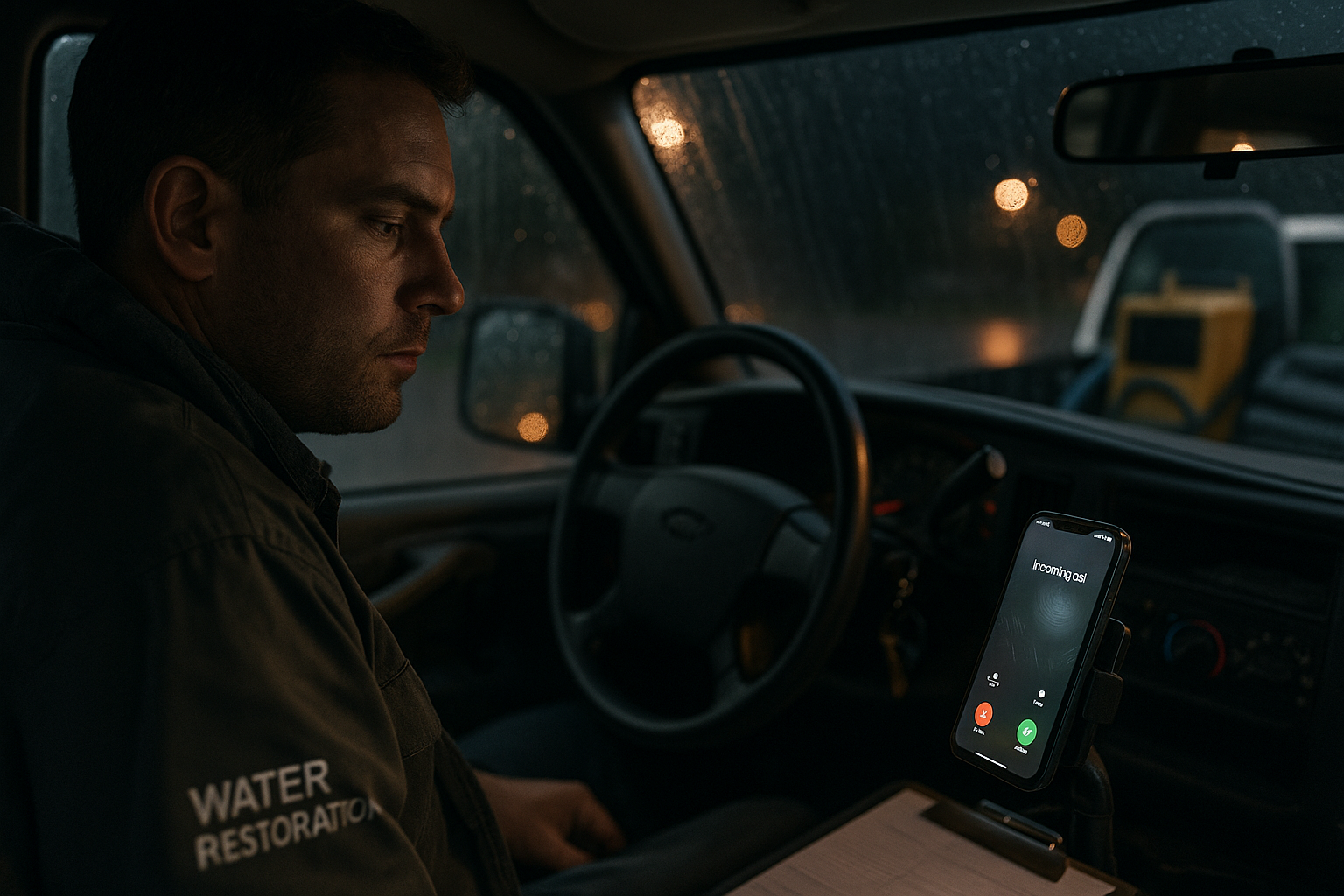
Water Damage Restoration Lead Response Time Matters
Quick Answer
Water damage restoration lead response time is the single biggest factor in winning emergency jobs worth $10K to $50K. Homeowners with burst pipes or flooding call the first company they find and hire whoever responds fastest. Restoration companies that respond in under 60 seconds through AI-powered automation capture significantly more jobs than those relying on after-hours answering services or next-morning callbacks.
A homeowner discovers a burst pipe at 1am. Water is pooling across the kitchen floor, seeping under cabinets, and dripping through the ceiling below. Panic sets in. The homeowner grabs their phone and searches for water damage restoration near them. They call the first company listed. No answer. They call the second. No answer. The third company responds in 42 seconds with an automated text, asks about the situation, and dispatches a crew. That company just won a $15K to $30K water damage restoration job because of water damage restoration lead response time.
According to InsideSales, 78% of leads go to the first business that responds. In water damage restoration, where emergencies happen at every hour and homeowners are in acute distress, that number is likely even higher. Response time is not a competitive advantage in this industry. It is the entire business model.
How Much Revenue Do Restoration Companies Lose to Slow Response?
Water damage restoration is a pure emergency service. Unlike a kitchen remodel where homeowners compare three bids over two weeks, a flooded basement demands immediate action. Every minute without mitigation increases property damage, mold risk, and repair costs. Homeowners are not evaluating marketing materials at 2am. They are calling anyone who will answer and saying, "How fast can you get here?"
According to CallRail, 28% of business calls go unanswered. For restoration companies that rely on after-hours answering services or owner cell phones, the real miss rate during peak emergency hours (nights, weekends, storms) climbs much higher. According to CallRail, 85% of callers who reach voicemail will not leave a message or call back. They simply dial the next company on their screen.
The financial math is stark. A mid-sized restoration company receiving 40 emergency leads per month with an average job value of $25K and a miss rate of 30% loses approximately $300,000 per month in potential revenue. Even capturing 5 additional jobs per month at $25K each adds $125K in monthly revenue, or $1.5M annually. The difference between answering in 45 seconds and calling back in 45 minutes is measured in millions.
Why Does Every Minute of Response Delay Cost Restoration Jobs?
Water damage escalates exponentially with time. The Institute of Inspection, Cleaning and Restoration Certification (IICRC) classifies water damage in categories and classes that worsen with every hour of exposure. Category 1 clean water from a burst supply line can become Category 2 or Category 3 contaminated water within 48 to 72 hours if not addressed.
Homeowners instinctively understand this urgency, even without knowing the technical classifications. They can see water spreading, hear dripping inside walls, and smell moisture building. According to Harvard Business Review, leads contacted within 5 minutes are 21 times more likely to convert than those contacted after 30 minutes. In water damage restoration, the conversion window is even tighter because the homeowner's decision is not "should I hire someone" but "who can get here first."
Insurance companies add another pressure layer. Most homeowner insurance policies require reasonable mitigation efforts to prevent further damage. Homeowners know they need to act fast or risk coverage complications. According to Salesforce, 64% of consumers expect real-time responses when contacting a business. For a homeowner standing in two inches of water at midnight, "real-time" means right now, not in 10 minutes.
How Do Top Restoration Companies Achieve Sub-60-Second Response?
The restoration companies winning the most emergency jobs are not staffing 24/7 call centers. They are using AI-powered automation to ensure every lead gets an immediate response, regardless of when it comes in. Here is how a sub-60-second response system works for water damage restoration.
AI-Powered Call Answering
An AI receptionist answers every call on the first ring, day or night. It asks the homeowner about the type of water damage (burst pipe, flooding, sewage backup, roof leak), the affected area, and the property address. It confirms whether anyone is in immediate danger. It provides reassurance that help is on the way and books a dispatch window. The entire call takes 2 to 3 minutes, and the homeowner hangs up knowing a crew is coming.
Instant SMS Follow-Up for Missed Calls
If a homeowner calls while on hold with another company or hangs up before connecting, an automated SMS goes out within 60 seconds. The text identifies the company, acknowledges the emergency, and asks the homeowner to describe the situation via text. According to HubSpot, SMS messages have a 98% open rate compared to 20% for email. A text that says "We saw you called about water damage. How can we help right now?" converts missed calls into active conversations.
Automated Dispatch and CRM Integration
Once the AI captures the lead information, it flows directly into the restoration company's CRM, creating a new job record with all the details: damage type, location, urgency level, and insurance status. The system can alert the on-call technician via text and email simultaneously, reducing the time between intake and dispatch. This eliminates the bottleneck of a single dispatcher managing calls, crews, and scheduling manually.
Restoration Company Response Time: The Revenue Impact
A water damage restoration company in a metropolitan market serving 200,000 households receives an average of 50 emergency leads per month. Without an AI-powered response system, the company captures approximately 60% of leads during business hours and 25% of after-hours leads. With AI automation, capture rates jump to 95% or higher across all hours.
| Response Metric | Manual / Answering Service | AI-Powered Automation |
|---|---|---|
| Average response time | 15-45 minutes | Under 60 seconds |
| After-hours lead capture | 25-40% | 95%+ |
| Weekend/storm surge capacity | Limited by staff availability | Unlimited simultaneous leads |
| Lead info captured per call | Name and phone only | Full intake (damage type, address, insurance, photos) |
| Monthly revenue from captured leads (at $25K avg) | $500K-$625K | $950K-$1.1M |
The revenue difference between a 15-minute response and a 60-second response is not marginal. For a restoration company doing $6M annually, improving response time to under a minute could add $2M to $4M in additional annual revenue from leads that competitors let slip through.
Every Minute Costs You a $25K Restoration Job
See how sub-60-second AI response captures more emergency leads for your restoration company.
Book Your Free Strategy CallWhy Storm Seasons Expose Response Time Weaknesses
Storm seasons create the highest-revenue opportunities and the biggest response time failures for restoration companies. A major rainstorm, hurricane, or freeze event can generate 10 to 20 times the normal call volume in a single night. Restoration companies running manual dispatch systems or small answering services get overwhelmed instantly. Calls go to voicemail, the callback list grows to 30 or 40 names, and by the time the team starts returning calls the next morning, half those homeowners have already hired a competitor.
AI-powered response systems handle surge volume without degradation. Whether 3 calls come in simultaneously or 30, every homeowner gets an immediate response. The AI captures damage details, provides reassurance, and queues jobs for dispatch in priority order. This surge capacity is the single biggest operational advantage for restoration companies during storm events, when a single weekend can generate $500K or more in emergency work.
According to HubSpot, 80% of sales require five or more follow-up touches. During storm surges, the restoration companies that not only respond first but also follow up persistently with homeowners who could not be served immediately build a pipeline that generates revenue for weeks after the event. An AI system automates this follow-up, keeping the company top of mind for homeowners who are still dealing with damage days or weeks later.
The difference between the real cost of a missed call during normal operations and the cost during storm season is staggering. A missed call on an average Tuesday might represent a $15K job. A missed call during a major storm event, when demand far exceeds supply, could represent a $40K to $50K job with premium emergency pricing. Restoration companies cannot afford to let storm-season leads go unanswered when their annual revenue depends on these high-volume periods.
The 5-minute response rule that applies to contractors generally becomes a 60-second rule in water damage restoration. By the time 5 minutes pass, the homeowner has already called two or three other companies. In this industry, speed is measured in seconds, not minutes.
Frequently Asked Questions About Water Damage Restoration Response Time
What is a good lead response time for water damage restoration companies?
Under 60 seconds is the benchmark for water damage restoration lead response time. Homeowners dealing with active water damage call multiple companies in rapid succession and commit to the first one that provides a clear, immediate answer. Companies using AI-powered automation achieve sub-60-second response consistently across phone, text, and web inquiries around the clock. Traditional answering services typically take 15 to 45 minutes to relay a message and get a callback initiated, by which point the homeowner has already hired someone else.
How do restoration companies handle call surges during storms?
AI-powered response systems handle unlimited simultaneous inquiries without delays, dropped calls, or hold times. During storm events that generate 10 to 20 times normal call volume, every homeowner receives an immediate response. The AI captures damage type, property address, urgency level, and insurance information, then queues jobs for dispatch in priority order. This surge capacity is impossible to replicate with manual dispatch, answering services, or even a fully staffed call center during unpredictable weather events.
Does faster response time actually increase revenue for restoration companies?
Directly and measurably. Water damage restoration jobs average $10K to $50K each. A restoration company that captures just 5 additional emergency jobs per month by responding in under 60 seconds instead of 30 minutes adds $50K to $250K in monthly revenue. The math is simple: faster response equals more jobs won. Slower response equals more jobs lost to the competitor who answered first. There is no industry where lead response time has a more direct impact on revenue than emergency restoration.
Speed Wins Every Water Damage Job
Water damage restoration is a race. The homeowner with a flooded basement at 2am is not reading reviews, comparing websites, or requesting proposals. They are calling companies and hiring the one that picks up. Every second of delay between a homeowner's first call and your response is a second closer to losing that $10K to $50K job to a competitor.
AI-powered lead response eliminates the gap between when a homeowner calls and when your company responds. It answers instantly, captures the critical details, reassures the homeowner, and triggers dispatch, all in under 60 seconds. During storm surges when 20 calls come in simultaneously, every homeowner gets the same immediate attention.
The restoration companies growing fastest are not the ones with the biggest trucks or the most certifications. They are the ones that answer first.
Stop Losing Emergency Jobs to Slow Response
Book a free strategy call and see how sub-60-second response captures every water damage lead, 24/7.
Book Your Free Strategy Call